Duy Le, PhD
Machine Learning & Computational Physics Researcher
Melbourne, Australia
đź“§ Email: duytrangiale@gmail.com
đź”— LinkedIn: linkedin.com/in/duytrangiale
đź’» GitHub: github.com/duytrangiale
📚 Google Scholar: scholar.google.com
About
I am a research engineer with a PhD in computational physics and deep learning, working at the intersection of:
- physics-based simulation
- scientific computing
- neural network surrogate models
My recent work focuses on developing deep-learning surrogates for granular flow simulations, replacing expensive Discrete Element Method (DEM) solvers with fast, data-driven models while preserving physical fidelity.
I am particularly interested in research and engineering roles involving ML for physical systems, AI for engineering applications, and scientific computing.

Research Interests
- Machine learning for physical and engineering systems
- Surrogate modelling for numerical simulations
- Discrete Element Method (DEM) and granular materials
- Scientific computing and high-performance computing (HPC)
- 3D geometry and dynamics systems
- Physics-informed machine learning and data-driven modelling
Highlights
-
🎓 PhD in Computational Physics & Deep Learning
Federation University, Australia – Thesis: Accelerated Surrogate Modelling of Granular Materials using Artificial Neural Networks.
-
🧠Developed deep-learning surrogates achieving 70–120× speedups over DEM simulations while maintaining physically meaningful behaviour.
-
đź’» Built large-scale data pipelines and training frameworks for 3D particle simulations, using Python, PyTorch, NumPy/Pandas, and Slurm-based HPC workflows.
-
đź“„ First author of peer-reviewed publications in machine learning, computer vision, robotics, and granular materials.
Selected Projects
1. Neural Surrogate for 3D Granular Flow
Keywords: Deep learning, discrete element method, surrogate modelling, scientific ML
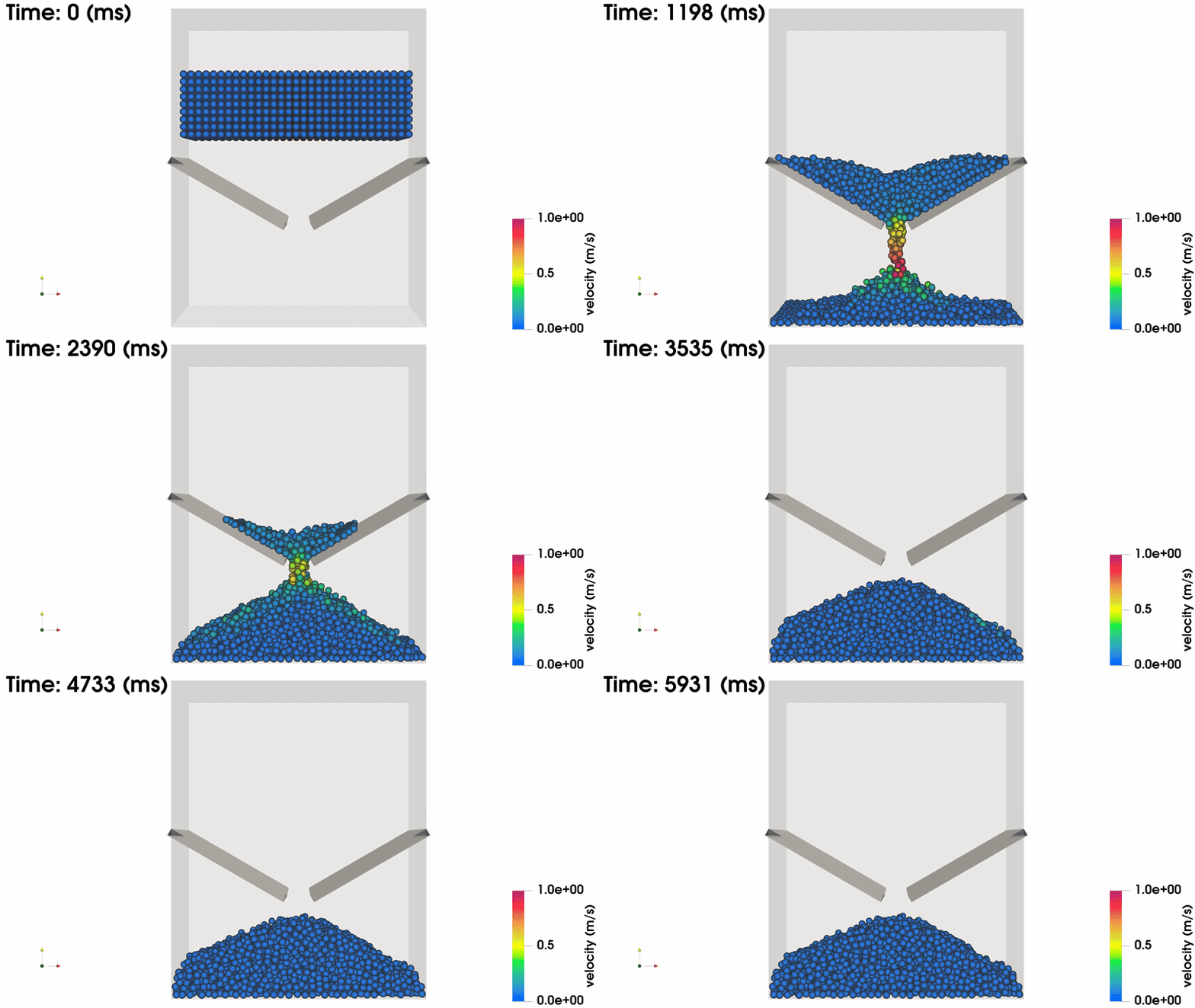
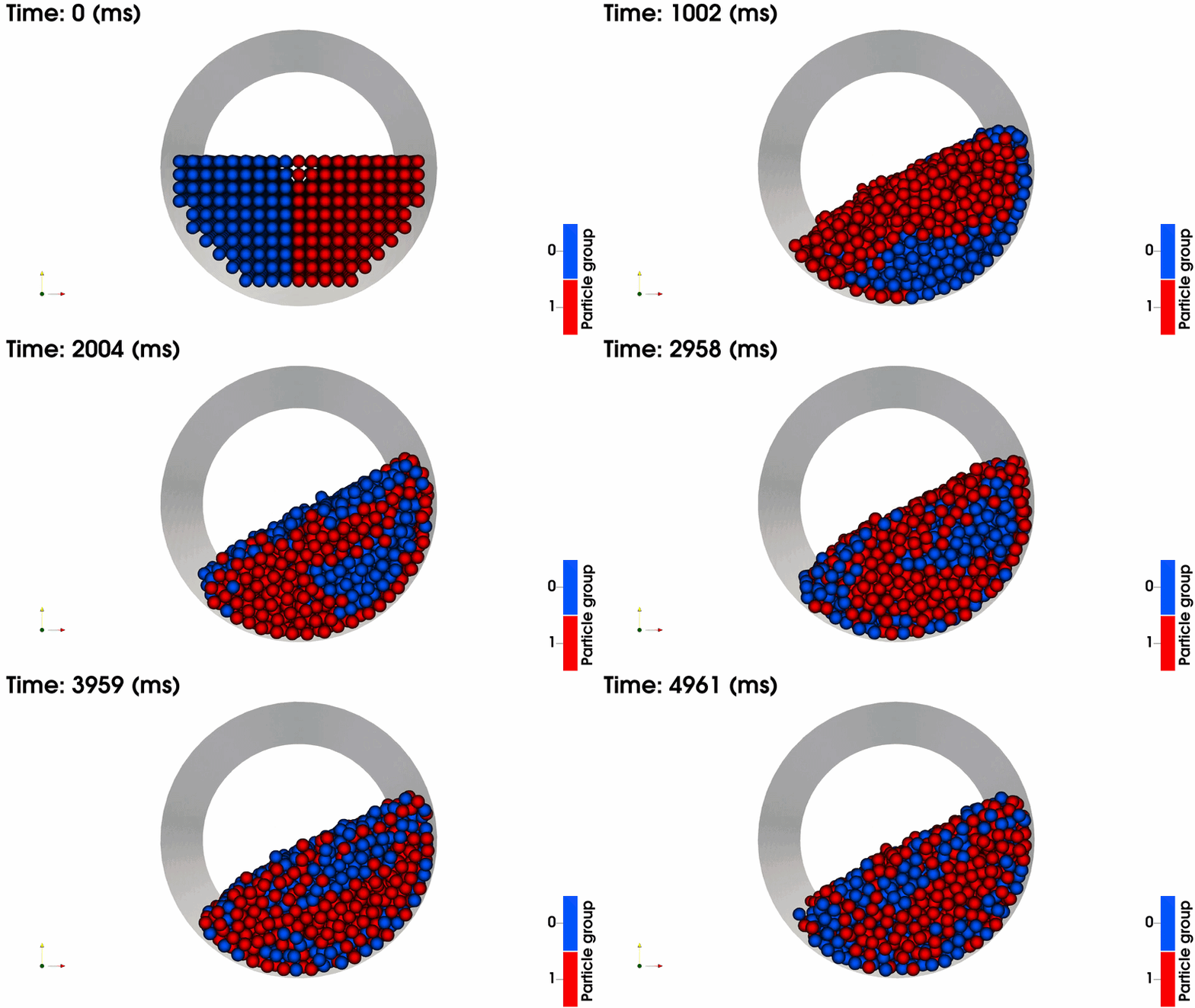
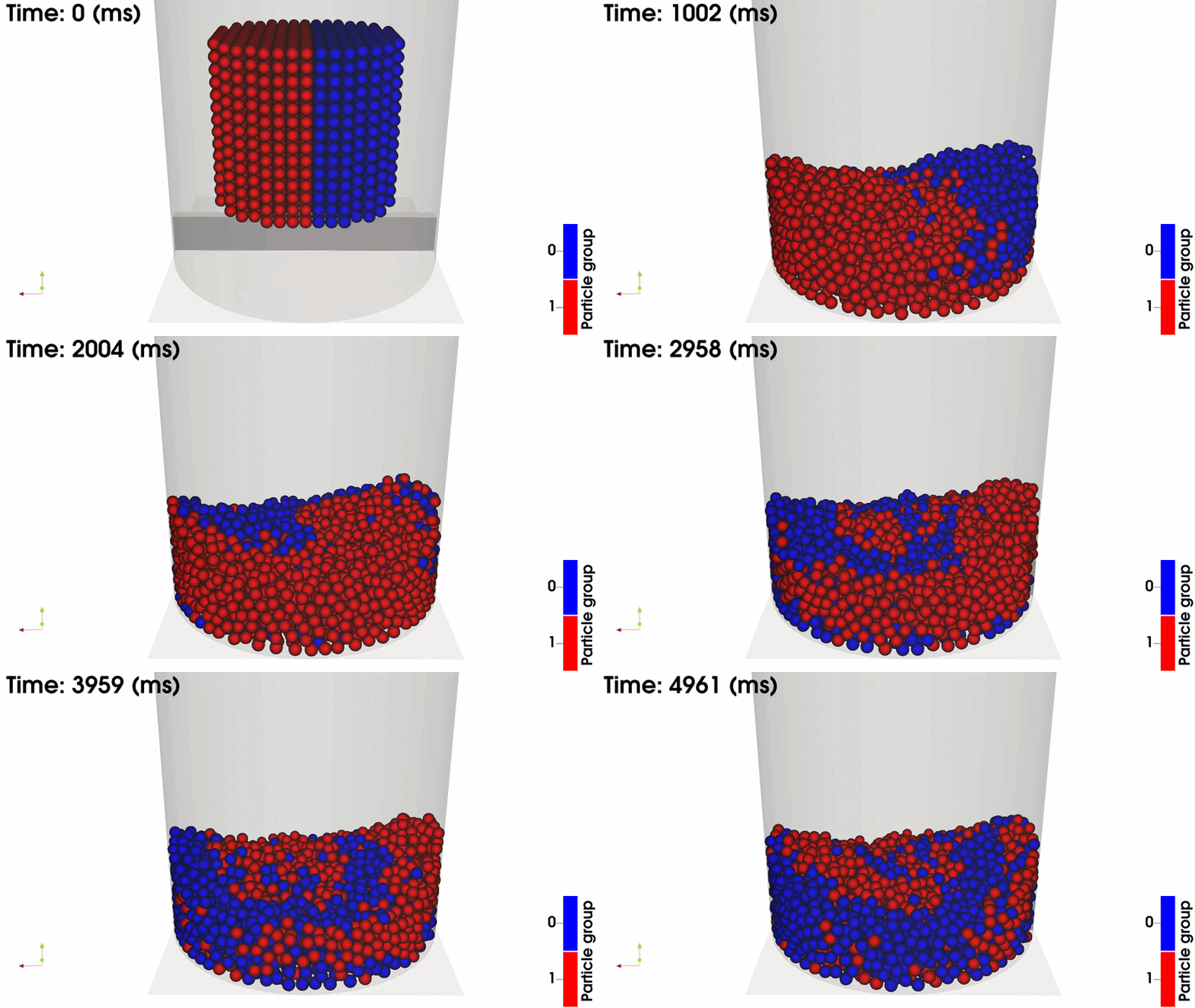
- Developed a deep neural surrogate model to approximate 3D granular flow dynamics in industrial systems (e.g., hoppers, rotating drums, mixers), replacing computationally expensive Discrete Element Method (DEM) simulations.
- Designed 3D continuous convolutional architectures to model particle–particle and particle–boundary interactions directly from spatial data, enabling accurate learning of complex contact dynamics.
- Achieved 70–120× speedup over high-fidelity DEM while preserving key physical behaviours, including mixing dynamics, energy evolution, and collision-driven interactions.
- Built an end-to-end ML pipeline: large-scale DEM data generation, preprocessing of particle states, distributed training on HPC (Slurm), and physics-based evaluation metrics for validation.
- Validated the model against DEM baselines using physically meaningful metrics (e.g., kinetic energy, mixing entropy, collision statistics), demonstrating strong generalisation across operating conditions.
Publications:
- “A Neural Network Surrogate for Modelling Granular Flow Dynamics in Industrial Applications with Dynamic Boundary Conditions”, Powder Technology, 2026.
- “Machine Learning Accelerated Prediction of 3D Granular Flows in Hoppers”, The 33rd International Conference on Artificial Neural Networks, 2024.

Neural surrogate prediction of 3D granular flows in industrial machines
Keywords: Scientific computing, data analysis, physical validation
- Developed Python utilities to process DEM simulation outputs into ML-ready datasets.
- Implemented computation of physically relevant metrics:
- mixing entropy and composition profiles
- translational and rotational kinetic energy
- angular velocity fields and alignment measures
- collision-based metrics such as coefficients of restitution
- Used these tools to benchmark neural network surrogates against high-fidelity DEM baselines.
3. Low-Cost Pseudo-LiDAR for 3D Object Detection
Keywords: Computer vision, 3D perception, pseudo-LiDAR, autonomous driving
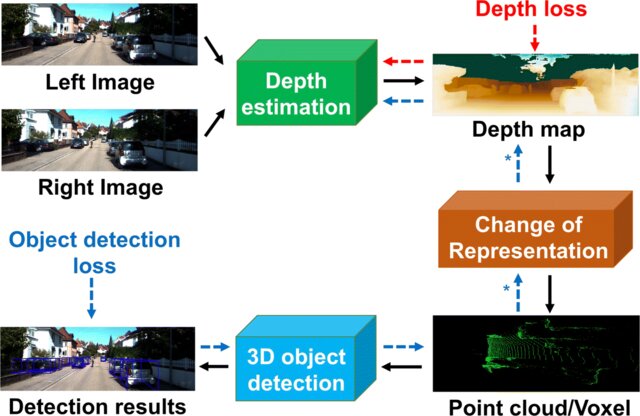
- Proposed a low-cost pseudo-LiDAR pipeline that reconstructs 3D structure from monocular imagery by integrating SLIC-based superpixel segmentation with depth estimation, enabling structured and efficient point cloud generation.
- Designed a region-aware depth refinement strategy, leveraging superpixels to enforce spatial consistency and reduce noise in reconstructed 3D geometry.
- Converted image-derived depth maps into LiDAR-like point cloud representations, allowing the use of standard 3D detection pipelines while avoiding expensive LiDAR sensors.
- Evaluated the approach on 3D object detection tasks, demonstrating competitive performance for camera-based perception and highlighting the feasibility of cost-efficient alternatives to LiDAR systems, which are typically expensive despite their accuracy.
- Showed that improved data representation (pseudo-LiDAR format) significantly enhances detection performance compared to conventional image-based methods, aligning with findings that representation plays a key role in bridging the gap with LiDAR-based systems.
Publication:
“Simple linear iterative clustering based low-cost pseudo-LiDAR for 3D object detection in autonomous driving”, Multimedia Tools and Applications, 2023.

3D object detection based on the pseudo-LiDAR
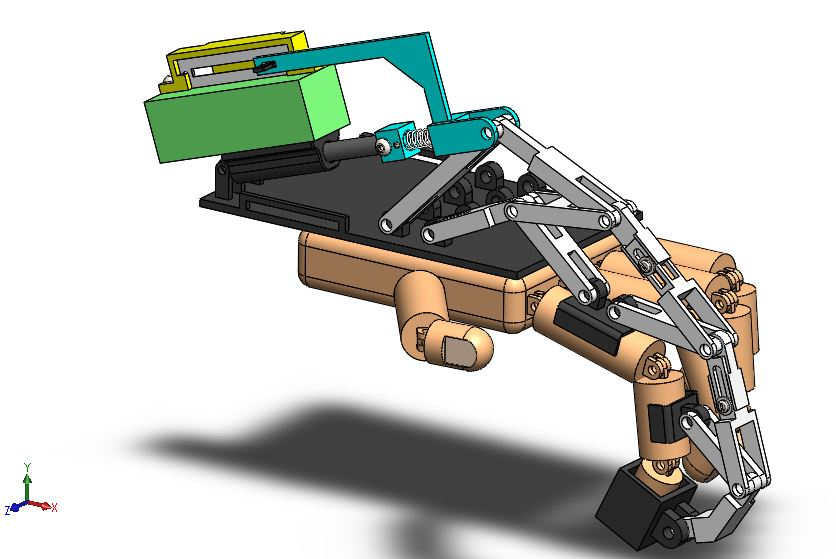
4. Haptic Hand Exoskeleton for Virtual Reality Applications
Keywords: Robotics, haptics, mechatronics, human-machine interaction
- Designed and implemented a force-controllable hand exoskeleton capable of delivering direct fingertip force feedback while preserving natural finger motion.
- Developed a bio-inspired linkage mechanism based on human finger kinematics, enabling accurate force transmission and ergonomic interaction.
- Integrated a series elastic actuator (SEA) system (linear motor, spring, and sensing) to achieve stable, controllable, and compliant force feedback.
- Analysed and optimised the force transmission characteristics to ensure effective feedback at the fingertips during interaction with virtual objects.
- Demonstrated the system’s ability to provide realistic haptic sensations in VR environments, improving immersion while maintaining a lightweight and low-cost design.
Publications:
- “An Efficient Force-Feedback Hand Exoskeleton for Haptic Applications”, International Journal of Intelligent Robotics and Applications, 2021.
- “A Design of Haptic Hand Exoskeleton for Virtual Reality Applications”, ASYU 2021 (IEEE).

Force-feedback hand exoskeleton for virtual reality applications
Keywords: Systems engineering, mechatronics design, project delivery, real-world problem solving
- Developed a complete engineering solution to a real-world problem, progressing from problem definition through to final validated prototype within a multidisciplinary team environment.
- Translated stakeholder needs into quantifiable engineering requirements, including performance targets, operational constraints, and evaluation metrics.
- Performed concept generation and trade-off analysis, comparing multiple design approaches based on feasibility, cost, performance, and implementation complexity.
- Designed and implemented a functional prototype, integrating mechanical, computational, and/or data-driven components depending on system requirements.
- Conducted testing and validation against defined metrics, analysing system performance and identifying limitations under realistic operating conditions.
- Applied iterative design and refinement, improving system performance based on experimental results and engineering analysis.
- Delivered detailed technical documentation and presentations, communicating design decisions, assumptions, and outcomes to both technical and non-technical stakeholders.

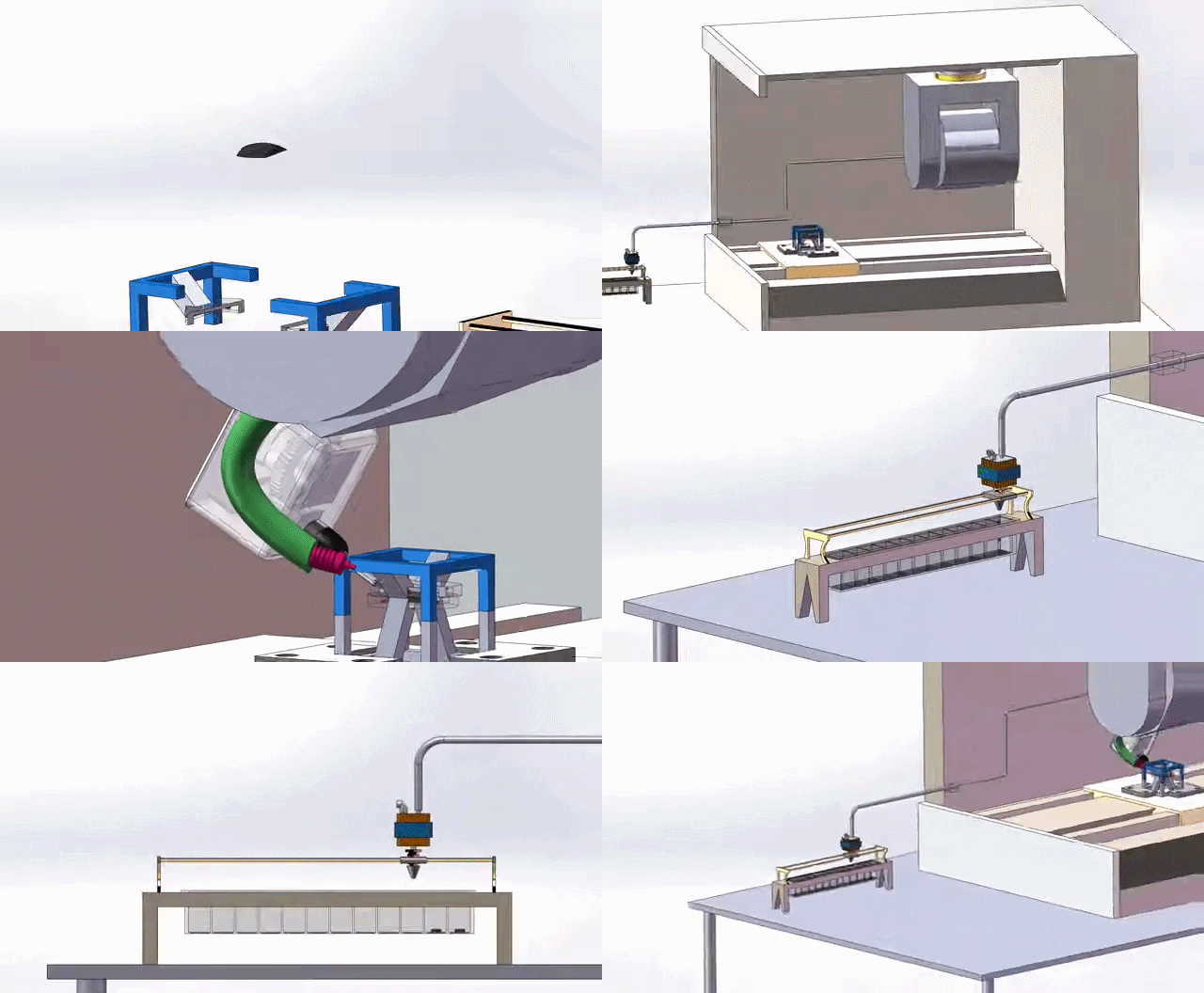
Demonstration of the automatic archaeological toolkit
Selected Publications
Below are a few representative works:
-
A Neural Network Surrogate for Modelling Granular Flow Dynamics in Industrial Applications with Dynamic Boundary Conditions
Duy Le, Gary W. Delaney, Linh Nguyen, Truong Phung, David Howard, Gayan Kahandawa, Manzur Murshed
Powder Technology, 2026.
-
Machine Learning Accelerated Prediction of 3D Granular Flows in Hoppers
Duy Le, Linh Nguyen, Truong Phung, David Howard, Gayan Kahandawa, Manzur Murshed, Gary W. Delaney
33rd International Conference on Artificial Neural Networks (ICANN), 2024.
-
Simple linear iterative clustering based low-cost pseudo-LiDAR for 3D object detection in autonomous driving
Duy Le and Linh Nguyen
Multimedia Tools and Applications, 2023.
-
An Efficient Force-Feedback Hand Exoskeleton for Haptic Applications
Duy Le and Linh Nguyen
International Journal of Intelligent Robotics and Applications, 2021.
-
An Efficient Multi-Vehicle Routing Strategy for Goods Delivery Services
Duy Le, Ying Men, Yunkang Luo, Yixuan Zhou, Linh Nguyen
IEEE International Conference on Advanced Robotics and its Social Impacts, 2021.
Skills Overview
Languages: Python, C, MATLAB, Java
ML/AI: PyTorch, TensorFlow, Scikit-learn, Open3D, Kubernetes, RAG, LLM
Data & Scientific Computing: NumPy, Pandas, SciPy, data pipelines
Simulation & Modelling: Discrete Element Method (DEM), numerical methods, optimisation
Tools: Git, Slurm, Linux, HPC clusters
Visualisation: Matplotlib, seaborn, ParaView
Other: CUDA (basic), LaTeX, scientific writing
Please feel free to reach out regarding opportunities in machine learning, scientific computing, and research engineering.